Human-AI Co-Creation ECCV 2026 Workshop Submit Paper
ECCV Workshop

Human-AI Co-Creation

Submit Paper

Human-AI Co-Creation explores how generative AI can become a collaborative partner that inspires, supports, and amplifies human creativity while preserving human agency and authorship.

Oct 10, 2026 ECCV 2026, Malmö, Sweden
Watercolor illustration of human-AI co-creation for ECCV 2026
Invited Speakers Four perspectives on creative Human-AI collaboration.
View all speakers →
About

About the Workshop

Human creativity rarely begins with precision.

At the earliest stages of visual creation, ideas are often incomplete, intuitive, and in motion. People sketch, improvise, borrow metaphors, follow sensations, and revise their intentions as they make. Yet many multimodal GenAI systems are still designed around explicit prompts and semantic correctness. This workshop asks how such systems can better support open-ended creative processes: not by replacing human imagination, but by helping people explore possibilities, refine emerging intent, and remain in control of meaning and authorship.

Bringing together generative modeling, human–AI interaction, design, and evaluation, we rethink GenAI as a medium for creative exploration rather than automated content production.

Call for Papers

Call for Papers

We invite submissions on multimodal generative AI and human-AI collaborative creation. The workshop focuses on GenAI as a collaborator, inspiration source, and assistant in open-ended, ambiguous, subjective, and iterative creative processes—while preserving human agency and authorship.

Submission Deadline July 3, 2026 23:59, Anywhere on Earth
Submit via OpenReview →

Topics of Interest

  • Human-centered GenAI models
  • Collaborative multimodal AI
  • GenAI for creative processes
  • Multimodal representation and alignment
  • Creativity-oriented HCI paradigms
  • Cognitive foundations of creativity
  • Human-centric benchmarks and evaluation
  • Novel applications for creativity
  • Ethical GenAI in creative domains

Important Dates

  1. Paper submission
  2. Review starts
  3. Review due
  4. Meta-review starts
  5. Meta-review due
  6. Notification
  7. Camera ready

Submission Format

  • Full papers 14 pages excl. references · archival · ECCV 2026 template
  • Extended abstracts 4 pages excl. references · non-archival · WIP or prior work

All submissions are reviewed double-blind by at least two reviewers, based on relevance, significance, novelty, technical quality, and clarity.

Submission Platform

All papers should be submitted through the OpenReview submission website.

OpenReview link announced soon

Keynote Speakers

Schedule Preview

Workshop Program

  1. Opening Remarks
  2. Invited talk #1
  3. Invited talk #2
  4. Spotlight
  5. Poster Break
  6. Invited talk #3
  7. Invited talk #4
  8. Closing

Organizers

Loris Bazzani

Adjunct Professor · University of Verona

Personal Page

Zanxi Ruan

PhD Candidate · University of Verona

Personal Page

Umberto Michieli

Research Scientist · Canva Research

Personal Page

Fabian Caba Heilbron

Research Scientist · Adobe Research

Personal Page

Nicu Sebe

Full Professor · University of Trento

Personal Page

Marco Cristani

Full Professor · University of Verona · Reykjavik University

Personal Page

Sponsor

← Back to main page
Invited Speakers

Speaker Biographies

Invited speaker #1

Chen Change Loy

Personal Page

Nanyang Technological University, Singapore

Chen Change (Cavan) Loy is a President’s Chair Professor at the College of Computing and Data Science, Nanyang Technological University (NTU), Singapore. He is the Director of MMLab@NTU and Co-Associate Director of S-Lab. He received his PhD in Computer Science from the Queen Mary University of London in 2010. Prior to joining NTU in 2018, he was a Research Assistant Professor at the Multimedia Laboratory (MMLab) at The Chinese University of Hong Kong from 2013 to 2018. Earlier, he worked as a postdoctoral researcher at Queen Mary University of London between 2010 and 2013.

His research interests include large multimodal models, generative AI, spatial intelligence and representation learning. His work has significantly advanced image and video super-resolution and face restoration. Notable contributions include pioneering deep-learning approaches such as SRCNN, ESRGAN, GLEAN, CodeFormer, and the BasicVSR series. His publications have received over 120,000 citations with an h-index of 141, and many of his methods are widely adopted in both academia and industry.

Cavan is recognized among the 100 Most Influential Scholars in Computer Vision by AMiner from 2020 to 2025. His awards include the NRF Investigatorship, the IIT Bombay International Award, the Nanyang Research Award, and the CCF-CV Test of Time Award.

He has served as Associate Editor for leading journals including IEEE Transactions on Pattern Analysis and Machine Intelligence (TPAMI), International Journal of Computer Vision (IJCV), and Computer Vision and Image Understanding (CVIU). He has also served as Area Chair or Senior Area Chair for major conferences such as CVPR, ICCV, ECCV, ICLR, and NeurIPS, and has co-organized multiple workshops and challenges at top computer vision conferences. He currently serves as Program Co-Chair of CVPR 2026 and will serve as General Co-Chair of ACCV 2028.

Invited speaker #2

Mira Dontcheva

Personal Page

Adobe Research

Mira is senior principal scientist at Adobe leading research in Human Computer Interaction (HCI) at the intersection of video interaction and AI agents. Mira leads the STORIE Lab, which focuses on research on storytelling and interactive experiences with generative AI. Mira and her team build new tools that make video and audio creation easier, more fun, and more accessible to a wider audience. She is passionate about multimodal interaction, AI agents, and experiences at the intersection of the physical and digital world. She finished her Ph.D. in computer science at the University of Washington with David Salesin, Michael Cohen and Steven Drucker. Her thesis focused on novel interaction techniques for collecting and organizing web content. She was an undergraduate at the University of Michigan in Ann Arbor and completed her B.S.E. in Computer Engineering.

Mira helped write and edit: No Code Required: Giving Users Tools to Transform the Web, was featured on Forbes.com and helped lead Project Blink. She has presented her research on stage at Adobe Summit and Adobe MAX.

Invited speaker #3

Fabio Pellacini

Personal Page

University of Modena and Reggio Emilia, Italy

Fabio Pellacini is a Full Professor of Computer Science at the University of Modena and Reggio Emilia, Italy. His research focuses on the use of computer graphics methods to address design problems, with particular emphasis on creative, design, and entertainment industries. His work combines algorithms, efficient systems, numerical methods, and machine learning to support intuitive and interactive creation of complex 3D scenes, enabling both professional designers and novices to work with significantly less effort.

Before joining the University of Modena and Reggio Emilia, Italy, he was an Associate and Full Professor at Sapienza University of Rome, an Assistant and Associate Professor at Dartmouth College, a Visiting Assistant Professor at Cornell University, and a researcher in the R&D division of Pixar Animation Studios. He received his M.S. and Ph.D. in Computer Science from Cornell University and a Laurea degree in Physics from the University of Parma.

Pellacini has made significant contributions to appearance design, material and lighting editing, appearance fabrication, visualization of design workflows, and cloud-based collaborative design. He has received a National Science Foundation CAREER Award and an Alfred P. Sloan Fellowship, and regularly publishes in leading computer graphics venues.

Invited speaker #4

Yuhui Yuan

Personal Page

Canva

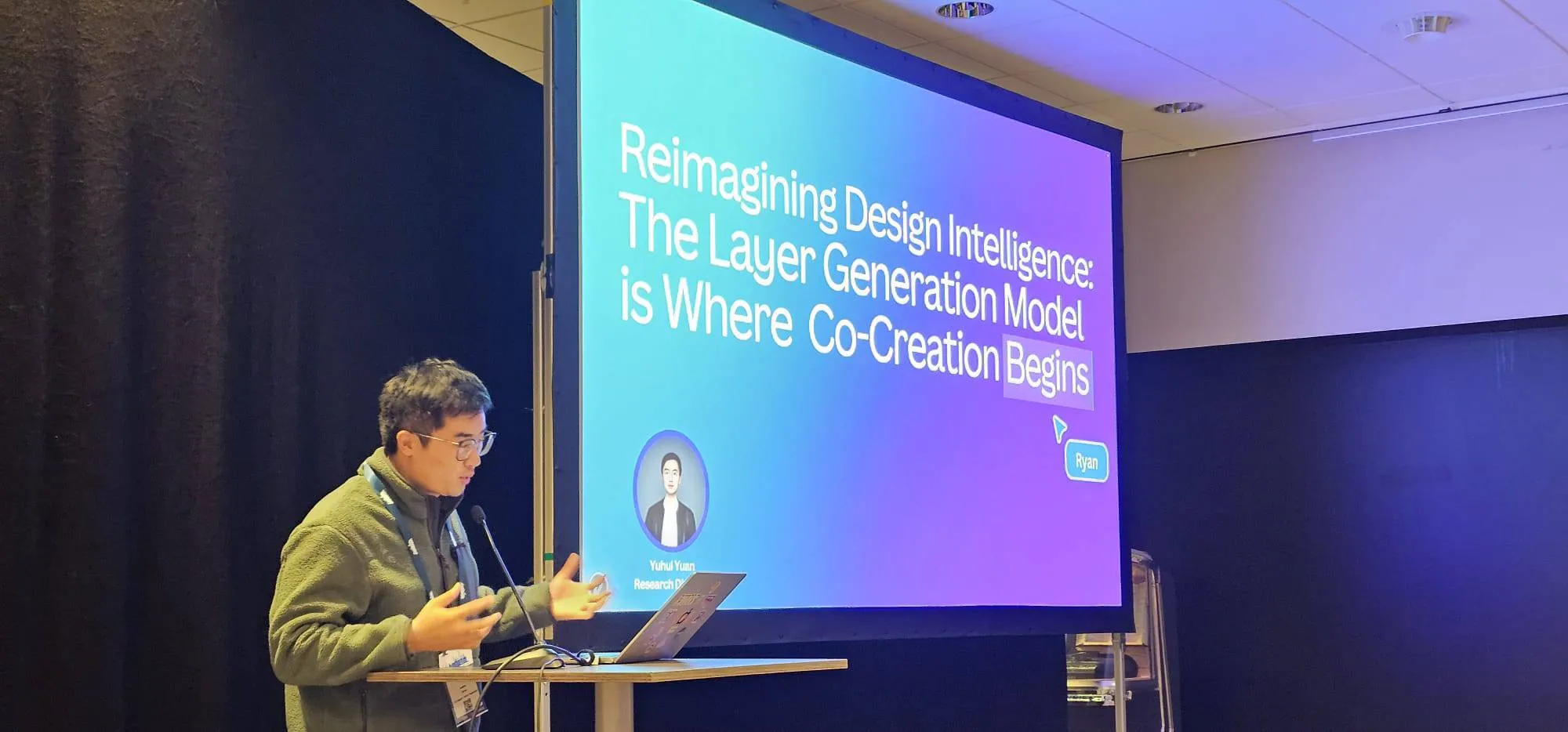
Yuhui (Ryan) Yuan is a Research Director at Canva CORE and the founder of Canva Research Lab in China, where he leads a research team focused on building next-generation graphic design foundation models. His current work centers on frontier multimodal generation, multi-layer visual content generation, and graphic design editing models, with the goal of advancing AI systems that can transform how people create and edit visual content.

Before joining Canva, he spent eight years at Microsoft as a Senior Researcher, working on cutting-edge computer vision problems including semantic segmentation, object detection, scene understanding, document intelligence, and generative AI applications. Several of his research contributions have been integrated into Microsoft products, including Azure Form Recognizer and Microsoft Designer.

Ryan received his Ph.D. in Computer Vision from the University of Chinese Academy of Sciences, where he worked on semantic segmentation, and his M.S. in Computer Science from Peking University. His representative research includes works such as OCNet, OCRNet, HDETR, Glyph-ByT5, SPO, and ART, as well as publications in top venues including ICCV, ECCV, IJCV, and ICLR.